Picnic Cooler Bag Zipper and Seam Test: 4 Checks
A cooler bag keeps cold air in through the foam and keeps water out through the seams. Buyers spend the sample meeting pressing the foam and almost no time on the stitch line, which is where the first complaint comes from: a wet patch on the car seat after a picnic, traced back to a seam that wicked water from the melted ice along the thread. Four checks cover that path, and all four can run on one sample in an afternoon.
What a Cooler Bag Has to Keep Out
Two things get wet inside a cooler bag: meltwater from ice packs and condensation from cold drinks. Both travel along the same route, from the liner floor outward through any place the liner has been pierced. A stitch line is a row of holes, and every hole is a path. That is why the seam and the zip decide the outcome, while the foam specification decides only how long the bag holds cold.
The construction choice sets the baseline. A sewn liner joined to the shell and covered with seam tape behaves differently from a heat-welded liner, and both behave differently from a simple sewn seam with no tape. Knowing which one is being quoted is the first question, because the tests that follow only make sense against a construction.
Check 1: The Seam Tape and What It Covers
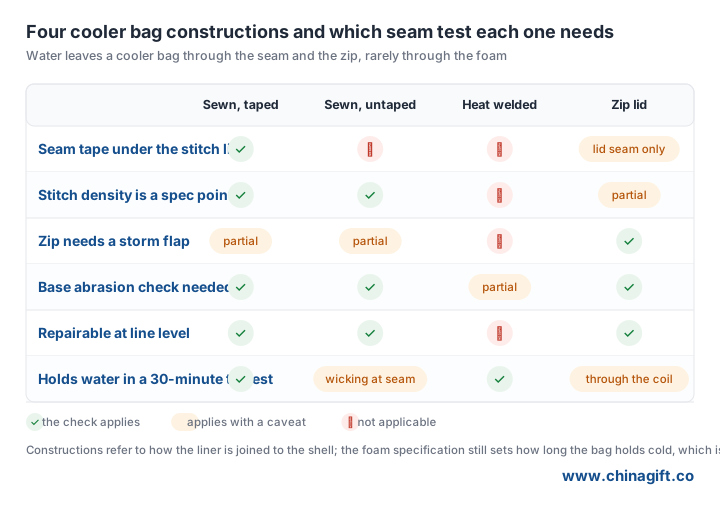
Seam tape is a strip of PU or TPU film, 10 to 15 mm wide, heat-applied over the stitch line on the inside of the liner. It seals the holes and stops the thread from acting as a wick. Check it three ways on the sample: press a fingernail along the tape to feel for a bubble or a lifted edge, pull the tape at the end of a seam to see whether it delaminates, and look at the inside corners, where tape is hardest to apply and where most failures start. Tape that stops 5 mm short of a corner is tape that does nothing at that corner.
If the quote does not mention seam tape, assume there is none. Untaped seams are common on promotional cooler bags and acceptable for a bag that carries sealed containers, not for one that carries ice.
Check 2: Stitch Density and Needle Size
A dense stitch line looks strong and behaves worse against water: more stitches per inch means more holes per inch. The working band for a cooler liner is 8 to 10 stitches per inch with a needle sized for the laminate, not the largest needle that fits the machine. Beyond 12 per inch the needle starts cutting the coating between holes, and a cut coating is a leak that no tape will seal.
Test it by counting stitches over a measured 25 mm on the sample seam and by looking at the holes with a loupe or a phone camera zoomed in. Holes that show a white ring of exposed substrate mean the coating has been cut. Holes that sit cleanly in the film with no halo are the ones that tape can seal.
Check 3: The Zip and Its Water Path
A zip is not a seal. Water passes between the coil elements unless something behind the zip blocks the path, which is what a storm flap does: a strip of liner fabric sewn behind the zip, wide enough to cover the coil line and long enough to run past both zip ends. Check that the flap exists, that it is sewn on the inside rather than the outside, and that it extends 20 to 30 mm beyond each end of the zip.
Then check the two ends. The zip end is where water leaves the bag, because the coil terminates and the tape ends. A zip that stops 10 mm short of the bag corner leaves an open channel; a zip that runs into the seam and is taped over closes it. On a moulded plastic zip, look for a coated or water-resistant variant before assuming the standard one behaves the same.

Check 4: The Base and the Corners
The base takes the abrasion and the weight, and it is the second place a cooler bag fails. A base panel in the same 600D fabric as the body is normal; a base panel in a lighter fabric saves cost and wears through where the bag is set down on concrete. Look for a separate base panel with its own seam, a bar tack at each corner, and a piping or binding that covers the raw edge.
Corners matter because they concentrate stress and because they are where seam tape is hardest to apply. Pull the corner of the sample by hand and watch the tape edge; if it lifts, the bag will leak at that corner after a few trips. Ask for the corner to be taped with a separate piece rather than a continuation of a straight run.
Running the Four Checks on a Sample
The water test is the summary of all four. Stand the sample in a tray, put two kilograms of ice in a sealed bag inside it, close the zip and tilt the bag 30 degrees for 30 minutes. Then wipe the outside dry and look at the tray for water, and at the seam line for a damp band. A bag that passes this test has tape that adheres, holes that tape can seal, a flap behind the zip and a base that does not wick.
Repeat the tilt in the other direction and with the bag on its side, because the corner that leaks is usually the one facing down. Record which seam leaked and photograph it; that photograph is the only evidence a factory will accept when the fix is disputed.
Put the requirements on the purchase order as four lines: seam tape material and width with corner treatment, stitch density per inch and needle size, storm flap width and its extension past the zip ends, and base panel fabric with bar tacks at the corners. Add the tilt test as the acceptance criterion, with the load, angle and duration written out.
Tell us the ice load, the carry style and the quantity, and we will quote the liner construction with tape and flap specified rather than assumed. Browse the picnic cooler bag range for the shapes these liners are built into, then request a sample and run the tilt test before the deposit.
Need promotional gifts for your campaign?
Send your brief and quantity for a quote and a digital proof.
Get a free quote


