Metal Keychain Plating Wear: 5 Finishes Ranked by Durability
Two keychain quotations with the same zinc alloy body and the same logo can differ by a wide margin on one line: finish. The line usually reads plating, occasionally reads plating colour, and almost never says which plating process or how thick. That single omission is what decides whether a keychain still looks presentable after a season in a pocket with keys and coins, and it is the first thing a returns complaint lands on.
Why plating wears at the high points first
Every plated or coated keychain fails the same way. The finish is a thin layer on top of a base metal, and the geometry of a keychain concentrates contact on the raised areas: the rim, the logo relief, the edge of the split ring hole. Keys and coins abrade those high points thousands of times, and once the layer is gone the base metal is exposed.
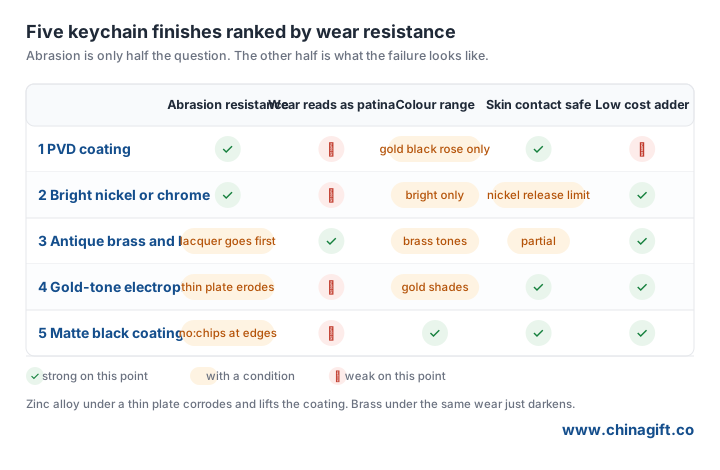
What happens next depends on the base metal more than on the finish. Zinc alloy under a thin plate corrodes into a white or grey bloom that spreads under the remaining coating and lifts it. Brass under the same wear turns darker and warmer, which many buyers read as patina rather than damage. This is why a finish that looks worse on paper can age better in a pocket, and why the ranking below separates resistance to abrasion from the appearance of the failure.
The five finishes, ranked by wear resistance
1. PVD coating. Physical vapour deposition lays down a hard ceramic-like layer that resists abrasion far better than any electroplated colour. It is the finish to specify when the keychain will live on a keyring with coins. The trade-off is colour: PVD covers gold tone, black and some rose tones well, and does not reproduce a bright chrome or a pastel.
2. Bright nickel or chrome electroplate. Hard, bright and inexpensive to apply, and it holds up to abrasion better than gold tone. The failure is slow dulling plus fine scratching rather than flaking. Watch the nickel: nickel-release limits apply to items in prolonged skin contact in several markets, and a nickel-free or nickel-reduced option is worth asking about before the order, not after.
3. Antique brass with a lacquer topcoat. Plated brass is chemically darkened, then lacquered. Abrasion resistance is decent, and the smart part is that wear reads as patina, so a keychain that loses lacquer in the recesses still looks intentional. The weak point is the lacquer itself, which is what fails first, usually as a cloudy patch that then collects dirt.
4. Gold-tone electroplate. The commercial default for corporate gifts, and the most sensitive to thickness. At flash thickness the colour erodes at the high points within weeks of pocket wear and the underlying nickel or brass shows as a pale patch. Specify the thickness in microns, and specify it for the raised areas the finish has to survive, not for a flat test panel.
5. Matte black coating. An electrophoretic or paint layer over the whole body, and the most visible failure of the five. Because the coating is opaque and the base metal underneath is bright, every chip reads as a silver dot. Edges, the ring hole and the logo relief chip first. It photographs beautifully and is the wrong choice for a keyring that shares a pocket with coins.

What each finish looks like when it fails
The practical value of the ranking is in recognising the failure mode, because it tells you whether a complaint is a finish problem or a handling problem.
PVD shows as fine scratches that do not change colour, and only becomes visible under raking light. Nickel and chrome dull evenly and pick up hairline scratches across the whole face. Antique brass clouds where the lacquer has gone, then darkens in the recesses as the bare brass oxidises. Gold tone shows pale patches at the rim and on the highest point of the logo. Matte black shows silver dots, first at machined edges and at the ring hole.
Three checks that settle a finish argument
Neutral salt spray. The standard corrosion test for plated goods. Ask for the hours achieved and the appearance criteria, not just a pass stamp, because a sample that shows minor discolouration at the edge at 24 hours and one that is clean at 48 hours are different products. Brass and zinc alloy behave differently in the same chamber, so the result is only comparable between parts made of the same base metal.
Cross-hatch tape adhesion. Score a grid through the finish, press a specified tape over it, pull, and count the squares that lift. This is the fastest way to catch a coating applied over an improperly cleaned surface, which passes a visual check and fails in the field.
Wet rub. Rub a saline-soaked cloth across the finish, then leave the part damp for an hour and check for colour change or bloom. Sweat is the real environment for a keychain, and this approximates it better than a dry rub. Run it on the highest point of the relief, not on a flat back.
Writing the finish into the order
A finish line that can be enforced names five things: the process, the colour reference, the thickness in microns, the base metal, and the test to be run with its acceptance criteria. Add the logo method, because a laser mark through a plated surface behaves differently from a printed one and the two cannot be swapped later.
Browse the metal keychain range for the body shapes these finishes are applied to, then send the artwork and the way the keychain will be carried, on a keyring with coins or clipped to a bag, and we will propose two finishes with the thickness and the salt spray result written into the quotation so the choice is comparable line by line.
Need promotional gifts for your campaign?
Send your brief and quantity for a quote and a digital proof.
Get a free quote


