Cardboard Display Stands: 3 Structural Tests Before Print
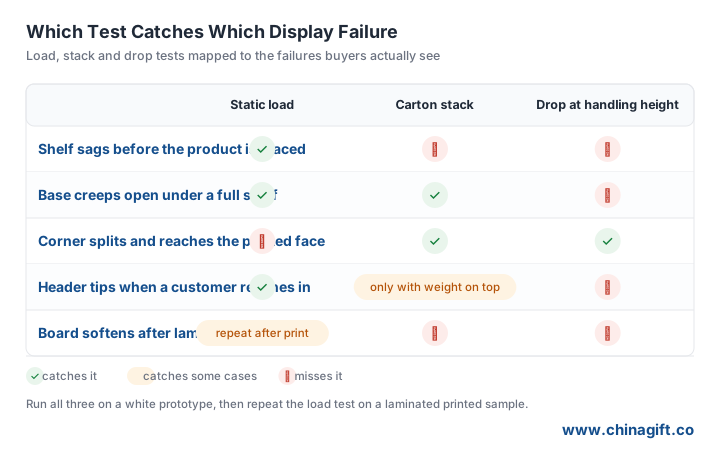
A cardboard display is tested before it is printed, not after. A white prototype that fails costs you a day and a knife cut; a printed display that fails costs the print run, the die, and the delivery window to the store. The three tests that catch most failures are simple enough to run in a factory corridor: a static load on every shelf, a stack test in the shipping carton, and a drop at handling height. Each one catches a different failure, and none of them replaces the others.
Why the Test Order Matters
Structural behaviour and print are connected. Laminating a sheet adds stiffness and also adds moisture, and moisture softens corrugated board. A display that passed a load test as bare board can sag once it is laminated and standing in a humid shop. Run the three tests on a white prototype first to settle the structure cheaply, then repeat the load test on a laminated printed sample before the bulk run.
The other order trap is the die. Once the cutting die is made, changing a shelf width or moving a slot means a new die. Every structural decision you postpone to the print stage is a die cost, which is why the prototype stage is where a display order is really won.
Test One: Static Load on Every Shelf
Load each shelf with the actual product, then add weight above what you expect, and leave it standing for 24 hours. Measure the shelf at the centre before and after: a sag of a few millimetres is normal for corrugated, a shelf that keeps moving after the first hour is not recovering, and a shelf that has visibly bowed will bow further once the store stacks a second product on it.
Watch the shelf-to-sidewall joint while the load is on. That joint carries the load into the side panel, and on a folded tab it can creep open. If the joint opens, the fix is a locking tab or an internal support, and both change the die.
Test Two: Stack Test in the Shipping Carton
Displays ship flat or partly erected, and they spend time in a stockroom under other cartons. Pack three cartons and stack them as they would be stacked in a container or a warehouse rack, then leave them for a full shift. What you are looking for is not the top carton; it is the bottom one, where the flute direction and the corner posts decide whether the display arrives with crushed edges.
Flutes should run vertically in the side panels so the board resists compression the way a column does. A side panel cut with horizontal flutes looks identical and carries a fraction of the load. Ask the factory to mark the flute direction on the dieline, and check it on the prototype with a fingernail.
A stack test also needs a humidity decision. Corrugated board loses a large part of its compression strength when it takes on moisture, so a carton that held at the factory in dry weather can crush in a container crossing a warm sea. Ask for the board grade with its moisture content, and stack the cartons in the most humid space you have access to if the retail market is tropical.
Test Three: Drop Test at Handling Height
A packed display unit gets dropped from the tailgate, off a pallet and onto a shop floor. Drop one carton on a corner, one on an edge and one flat, from the height a two-person lift is likely to fail at, and open them. Corner damage that reaches the printed face is a store rejection; corner damage contained in the pack is a cost you accept.
The drop test also exposes interior packing. A display that relies on the product box to hold its shape will arrive distorted if the product shifts. Foam or a corrugated insert at the corners is cheaper than a reprinted header.
What Print Changes
Lamination stiffens a panel and, on a large flat face, warps it. A warped header will not sit square in its slot, and the store will prop it against a wall instead of using the display. Ask for a laminated sample to be left flat for a day before assembly, and check the warp with a straight edge across the face.

Print coverage is the second change. A face with heavy ink coverage absorbs moisture differently from a white face, and on a humid shop floor that shows up as a curl at the edges. If the design is a full-bleed photo, test the printed sheet, not the white board.
What to Send the Factory
Product weight and dimensions, the number of shelves and the load on each, the pack quantity per carton, the stacking height in the container, and the shop environment (air conditioned or open frontage). Then state the acceptance: maximum shelf sag in millimetres after 24 hours, carton condition after stacking, and which corner damage is acceptable on a dropped unit. A test without an acceptance number is a demonstration.
Send the product size, the shelf count and the store format. We will cut a white prototype to those numbers, run the load and stack tests, and send photographs with measurements before anything goes to print. See the full cardboard display range for shelf and hook formats that already carry an internal support.
Need promotional gifts for your campaign?
Send your brief and quantity for a quote and a digital proof.
Get a free quoteRelated products
 Strong POP Cardboard Display Floor Display Stands For Hellokitty Backbag Mobile CaseCG18259
Adjustable Shelf POP Cardboard Display Cardboard Display Stand for Beauty Care ProductsCG18263
 Hook Floor Display Stand for Kids ShoesCG18281
 Fashionable POS Cardboard Display Stands Hook Floor Display for JewelleryCG18289
 Paper Cardboard Point Of Sale Display Stands Display Models for RED BULL Racing CarCG18300