Metal Keychain Load Tests: 5 Checks for Promotional Use
A promotional keychain is a small metal part that people hang their car keys on and then drop on concrete, so the failure that matters is not the printing rubbing off, it is the ring opening and a set of keys landing on a car park floor. Five checks cover that risk, and four of them need no laboratory: a hook, a weight, a metre of hard floor, a roll of tape and an eraser. Run them on the sample before you approve it, and write the pass figures into the purchase order.
Where a keychain actually breaks
The tag is almost never the weak point. On a die-cast zinc alloy tag the casting is thick relative to the load, and the failure appears at the attachment: the split ring, the jump ring that joins the ring to the tag, or the hole the ring passes through. The hole is the one buyers forget, because a plated casting with a thin section around the hole can crack through after a few drops, and the crack shows up as a hairline in the plating rather than an obvious break.
Material choice sets the ceiling. Stamped brass and stainless steel hold thin sections better than die-cast zinc alloy, so load figures change when the material changes. Ask which material the quote assumes before testing: a brass sample does not prove the zinc version.
Check one: static pull on the attachment point
Hang the keychain from a fixed hook, attach a weight to the ring, and hold it for 60 seconds. A practical starting figure is three times the load the item is meant to carry: a bunch of keys weighs a few hundred grams, so a 5 kg pull for one minute is a reasonable acceptance level and 10 kg separates the good parts from the marginal ones.
Watch three things while it hangs. The ring should not open at the gap, the jump ring should not straighten, and the tag should not rotate at the hole in a way that suggests the hole is ovalising. If the ring springs back closed when the weight comes off but leaves a visible gap, that is a fail: a gap of even a millimetre will let a key work its way out.
Check two: the one metre drop, five times
Load the keychain with a weight equal to what it will carry, hold it at one metre, and drop it onto concrete or a hard tile floor five times. Vary the angle so the tag lands flat, on edge and on the ring. This is the check that finds casting cracks and plating chips at the same time, and it is closer to real use than any static pull.
Inspect after each drop rather than only at the end, because the interesting failure is progressive. Note where the plating has lifted, whether the ring gap has widened, and whether the tag has bent. A tag that bends permanently was made from too thin a gauge or too soft an alloy, and no plating will fix that.
Check three: open and close the ring ten times
A split ring is a spring. Open it ten times with a ring opener or a fingernail, closing it fully each time, and check that it returns to the same closed position. A ring that stays slightly open after the tenth cycle has lost its temper, and it will snag on a pocket lining and let go. It costs a minute and catches the most common complaint on promotional keychains.
Also check the seam of the jump ring. A soldered joint should be smooth and closed; an unsoldered one needs a gap too tight to pull apart by hand. An unsoldered jump ring with a visible gap fails the static pull in check one.

Checks four and five: plating adhesion and engraving wear
Score a small cross-hatch through the plating on a flat area, press an adhesive tape over it, and pull the tape away at a shallow angle. Plating that comes away with the tape has poor adhesion, and it will fail in a pocket before it fails on a display card. It is the fastest test in the set and usually explains why two suppliers quoting one finish differ on durability.
For anything used outdoors, ask for salt spray hours and get them stated per finish rather than as a range. A salt spray figure without a stated finish and duration means nothing, and it is where a spec gets quietly softened between sample and bulk.
The fifth check is abrasion: rub the engraved or printed area with a soft eraser or a felt pad for twenty strokes and look at the result. Laser engraving on plated zinc alloy removes the plating and exposes the base metal, which then corrodes and turns the logo dark or green; the same laser on stainless steel is clean and permanent. Pad printing sits on top of the plating and wears at the edges first, so check the outline rather than the colour.
Decide which of those two outcomes you can live with before choosing the process. If the keychain is going to sit in a pocket with coins, a printed logo on a plated surface has a short readable life, and engraving on stainless is the version that still shows a logo after a year.
Putting the five checks into the order
Write each check as a line in the order with a number and a verdict, and attach the approved sample. Five lines is enough: static pull figure and duration, drop height and count, ring cycles, tape peel result, abrasion strokes. Add the material and the finish, and state that a material substitution requires a new sample.
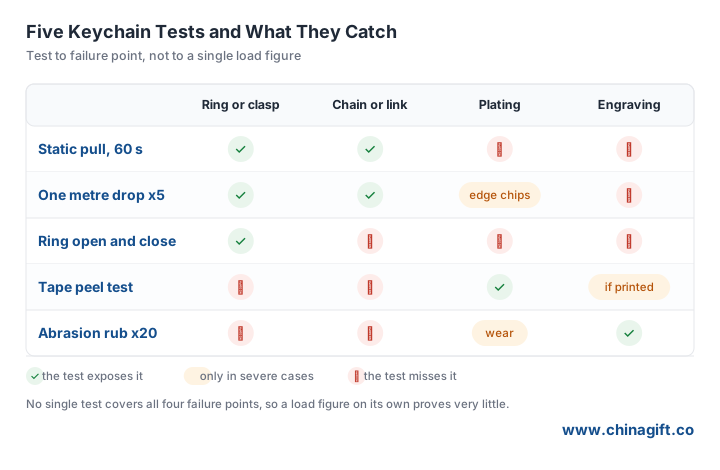
The same five lines work for every style in the metal keychain range. None of this needs a test house. A hook, a 5 kg weight, a stopwatch, a metre of hard floor, tape and an eraser will settle an approval in under half an hour, and the numbers that come out of it are the ones worth writing into the order. The alternative is discovering the ring gap in a customer complaint six months after the campaign closed.
Need promotional gifts for your campaign?
Send your brief and quantity for a quote and a digital proof.
Get a free quote


