Handmade Necklace Sourcing: 5 QC Points on Beads and Clasps
Bead tolerance, hole quality and clasp spring travel decide whether a handmade necklace sells at a gift counter or comes back as a complaint in week two. All three can be measured with a caliper, a loupe and a luggage scale, and each has a number you can put on a purchase order. The order below runs from the cheapest fix to the most expensive.
Measure twenty beads before you look at the necklace
A necklace photographed flat hides size variation that a customer sees immediately in a mirror. Take twenty beads at random from the lot, measure diameter with a vernier caliper to 0.01 mm and write every reading down. On a nominal 6 mm round bead, a spread of 0.3 mm across the lot is what most buyers accept; a spread of 0.8 mm reads as a visibly uneven strand and no amount of careful stringing fixes it.
Record two numbers: the spread, from smallest to largest bead, and the drift, the difference between the mean of the first twenty beads and the mean of twenty from a second bag. A tight spread with a large drift means one bag was graded and another shipped.
Oval and faceted beads need a second measurement across the short axis: a bead that is round in one direction and flat in the other strings into a twisted strand.
Turn every hole into a place the string will fail
Hole quality is the least photographed and most common failure. Look at both mouths of the hole under a 10x loupe and check for three things: chipping where the drill exited, crazing — the fine web of cracks around the rim that appears when the drill speed was too high — and burrs left inside the channel. Chipping and crazing both act as a knife edge against the string, and a necklace that breaks after a month almost always broke at a hole mouth.
Measure hole diameter as well. The string or wire should pass with clearance but not rattle: a hole of 1.0 mm taking a 0.6 mm cord leaves room for movement, and movement grinds the cord against the rim. If the hole is undersized, forcing a thicker cord through a bead is what produces the crazing in the first place, so ask for the hole diameter to be specified rather than assumed.
For pearls and coated beads, add one check: rub two beads against each other, not against a hard surface. A coating that scuffs to a lighter core at the contact point wears through at the knots.
The clasp is where returns come from
Spring travel is the number to test. Close and open a lobster clasp ten times and watch how far the gate opens; a clasp whose gate opens less than about 1 mm on a 10 mm body will not clear the jump ring reliably, and the customer experiences that as a necklace that will not fasten. Then pull the closed clasp against a 3 kg load for a minute: a gate that deforms or a spring that loses tension under that load is not a clasp, it is a decoration.
Plating and nickel release matter more than any other metal spec on a gift item. Nickel release is regulated in the EU at 0.5 micrograms per square centimetre per week on items in prolonged skin contact, tested to EN 1811, and clasps, ear wires and extenders are exactly the parts that fail it. Ask for the release test on the clasp and the chain ends rather than the finished necklace as a whole, because the plated findings are where the nickel is.
If the design uses a magnetic clasp, the number is holding force, and the failure is a necklace on the floor. Test the pair against a 2 kg pull, and check that the magnet is captive: a magnet that can be pushed out of its setting is a small-parts issue as well as a functional one.

Stringing, crimps and the knot that hides a defect
Ask how the strand is built before you ask how it looks. A knotted strand with a knot between every bead stops the loss of the whole necklace when one bead breaks; a continuous strand on nylon-coated wire fails completely at the first break. Neither is wrong, but the two should not be quoted at the same price and should not be described the same way.
On a wire-strung strand the crimp is the weak point. Check that the wire passes through it twice, that it is closed with a crimping tool rather than flat-nosed pliers, and that a bead cover hides it without glue. Then hang the necklace with a 2 kg weight for one minute: a crimp that slipped a millimetre will slip further in wear.
Check the tail as well: a bare wire end leaves a sharp point against the neck, and an unsealed hand-tied knot works loose.
Colour, coating and dye lot on the strand in front of you
Judge colour on the whole strand. Lay the necklace on a white card in daylight, then in shade, and look for the bead that reads warm against its neighbours. On dyed stone and glass, ask for the dye lot number and keep a signed reference strand, because a reorder from another lot will not match.
On coated and aurora finishes, rotate the strand and look for a dull patch or a visible coating edge; that edge is where the coating lifts first.
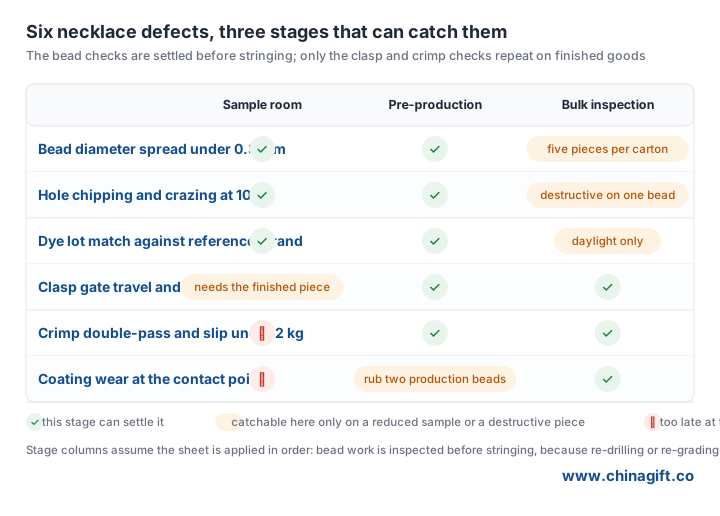
Put the five checks on one inspection sheet
One page per style, five rows, each with a method and a pass line: twenty beads measured for diameter spread under 0.3 mm and drift under 0.2 mm; hole mouths free of chips and crazing at 10x, hole diameter specified; clasp gate opening at least 1 mm and holding 3 kg for a minute; crimp double-passed and slip under 2 kg held for a minute; colour matched against the signed reference strand in daylight and shade.
Then apply the sheet three times: on the supplier's sample, on the first piece off the line, and on five pieces from the finished carton. It needs no lab, only a caliper, a loupe, a 3 kg weight and someone who writes the number down. The handmade necklace category shows the constructions these checks have to cover, from rhinestone settings to strung pearl strands.
Need promotional gifts for your campaign?
Send your brief and quantity for a quote and a digital proof.
Get a free quote


