Metal Keychain Manufacturing: Die Struck vs Die Cast vs Printed
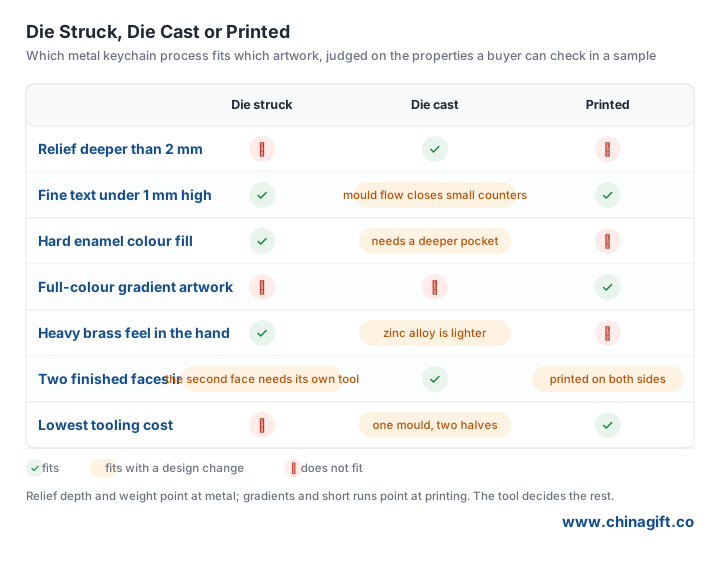
The artwork decides the process before the quotation does. A design with a 2 mm relief and a rounded body cannot be stamped, a design with a gradient sky cannot be cast, and a design with 1 mm lettering loses its counters in a mould. Sorting the artwork into one of the three families takes an afternoon and saves a tool.
Die Struck: Brass, Thin Relief, Sharp Edges
Die striking presses a brass blank between two hardened dies, and the metal flows into the cavities under pressure. The result is a dense part with crisp edges, which is why struck keychains hold small lettering and fine line work better than anything else in the family. The limitation is depth: the metal moves a limited distance before the die load becomes impractical, so a struck design lives in a shallow relief rather than a deep sculpture.
Struck parts are usually finished with enamel. Hard enamel fills the recesses and is then ground and polished flat with the metal surface, so the colour sits flush and the piece reads as a solid badge. Soft enamel leaves the colour recessed below the metal line, which produces a texture you can feel with a thumbnail. Both are legitimate, and the choice changes the perceived quality of the same drawing: hard enamel looks formal, soft enamel looks sporty.
Die Cast: Zinc Alloy and Deep Relief
Die casting injects molten zinc alloy into a steel mould. The mould is a cavity rather than a pair of pressing dies, so it can carry deep relief, undercuts, and a fully three-dimensional body: a shaped animal, a tool, a small vehicle. That freedom is the reason cast keychains dominate novelty shapes.
The trade is resolution. Molten alloy does not fill the tight corners that a struck die can hold, so small text and thin lines close up or blur. A cast design that needs legible lettering usually ends up with the text on a raised plate or on the reverse face, and the mould has to be designed with draft angles so the part releases. A cast part is also lighter than the same size in brass, which changes how the gift feels in the hand.

Printed: Full Colour Without Metal Relief
Printing puts the artwork on a flat metal plate, then covers it with a dome of epoxy or a lamination. There is no relief, so there is no die to pay for and no limit on colour count: gradients, photographs and small type all reproduce. For a campaign with a photographic key visual, printing is the only one of the three that carries the image intact.
The trade is the opposite of casting: the piece feels flat and light, and the printed surface is a coating rather than metal. An epoxy dome protects the print and adds a slight magnification that softens fine type, so a printed design with 1 mm lettering should be checked on the actual dome rather than on a flat proof.
Tooling, and the Second Face
Both metal processes need a tool, and a tool is paid once per design. A struck part needs a pair of dies for the front; a design on both faces needs a second operation and often a second die, which is why two-sided struck keychains cost more than the arithmetic suggests. A cast mould produces both faces in one shot because the mould has two halves, so a two-sided cast design is cheaper than a two-sided struck one.
Ask for the tool cost and the tool ownership in writing. A tool that stays with the factory is a tool you cannot move, and a reorder two years later depends on that mould still existing.
Plating Changes the Contrast, Not Just the Colour
Every one of the three processes ends with a plated surface, and the plating is what the enamel or the print sits against. Nickel reads cool and bright, brass reads warm, gold tone reads warmer still, and black nickel drops the metal line so far into the background that the colour field becomes the whole design. A struck design with hard enamel and black nickel plating looks like a different product from the same drawing in nickel.
Two constraints are worth knowing before the plating is chosen. A plated surface has to be masked where the enamel will sit, so a design with many small isolated colour areas costs more to mask than one with three large fields. And the plating thickness affects the edge: a heavy plate rounds a sharp die edge slightly, which is why a struck piece that depends on a crisp hairline should be specified before the plater is briefed, not after.
What to Send for an Accurate Quote
Four numbers and one file. The numbers are the size in millimetres, the relief depth you want, the number of enamel colours, and the quantity. The file is vector artwork with the plating noted: nickel, brass, gold tone or black nickel, each of which changes the contrast against the enamel.
Add the attachment and the backing. A jump ring, a ball chain and a key ring are different fittings, and a backing card changes the packing count per carton. None of these is expensive on its own; all of them are expensive when discovered after the tool is cut.
Send the artwork and the four numbers, and we will tell you which process the design actually needs before a tool is cut.
Need promotional gifts for your campaign?
Send your brief and quantity for a quote and a digital proof.
Get a free quote


