Conference Tote Printing: 1-Color vs Full Print at 500 Units
At 500 units the choice between one-colour and full print on a conference tote is not an ink cost decision, it is a setup cost decision. Screen printing charges a setup per colour, and that charge is fixed, so a single colour spreads one screen across 500 bags while a four-colour photographic design spreads four screens plus tight registration across the same 500. Understanding which part of the quote moves with quantity and which part does not is the whole comparison.
The Two Costs That Separate One Colour From Full Print
Every printed tote quote has two halves. The running cost is ink, labour and machine time per bag, and it barely differs between a one-colour logo and a four-colour one. The setup cost is the screen or plate making, the colour matching and the press setup, and it is charged once per colour regardless of quantity. At 5,000 units the setup disappears into the unit price. At 500 it does not, which is why the same artwork can look cheap at one quantity and expensive at another.
That is the practical answer to the question buyers ask most often: full print is not four times the ink, it is four times the setup. A quote that only shows a unit price hides this, so ask for the setup line separately and divide it by the quantity yourself.
What the Setup Charge Actually Is at 500 Units
For a one-colour screen print the setup is one screen, one colour match and one press alignment. For a two-colour logo it is two screens plus a registration step so the second colour lands on the first. For a four-colour process print it is four screens and a registration tolerance that has to hold across a fabric surface that stretches while it is being printed.
That last point is where the cost jumps rather than adds. Fabric is not paper: it moves under the screen, so holding four colours in register on a tote needs more squeegee passes and more rejects at the start of the run. A photographic design also needs a white base coat on a coloured or dark bag, because process inks are transparent and the bag colour shows through. That base coat is another screen and another pass through the dryer, and it is the line buyers forget when they compare a full-colour mock-up against a one-colour quote.
Full Bleed on a Tote: Coverage, Bleed and the Bag Shape
Full print on a flat sheet is straightforward. On a sewn bag it is a geometry problem. The print area is bounded by the side seam, the gusset fold and the handle anchors, and artwork that bleeds past those lines either stops short with a white margin or wraps onto a fold where the ink cracks. Ask for the flat bag dimensions and the seam allowance before finalising artwork, and design to the print area rather than to the bag outline.
Coverage also changes handling. A bag printed edge to edge on both sides has to be printed flat before sewing, which fixes the production order: print first, then sew. A one-colour logo can be printed on a finished bag on a carousel, which is more flexible if the order is late. If the event date is fixed and the artwork is still moving, that production order matters more than the ink cost.
Where the Extra Time Goes
Each colour adds a pass through the dryer and a chance to re-register, so a four-colour print runs slower per bag than a single colour on the same press. The bigger time item is the front end: screens have to be made and the colour has to be approved on a strike-off before the run starts. A one-colour job needs one approval. A four-colour job needs the whole design approved as a proof, and every revision after that means new screens.
This is the reason a late artwork change costs so much on full print and almost nothing on one colour. Once the screens exist, changing one colour means remaking one screen; changing a photographic layout means remaking all of them. If the marketing team is still deciding between two versions of a logo, one colour is the option that absorbs that indecision.
Choosing for a Conference: Three Scenarios
The decision usually falls into one of three cases, and the matrix below is the version we send with a quote because it shows which route carries a cost that the buyer can still avoid.
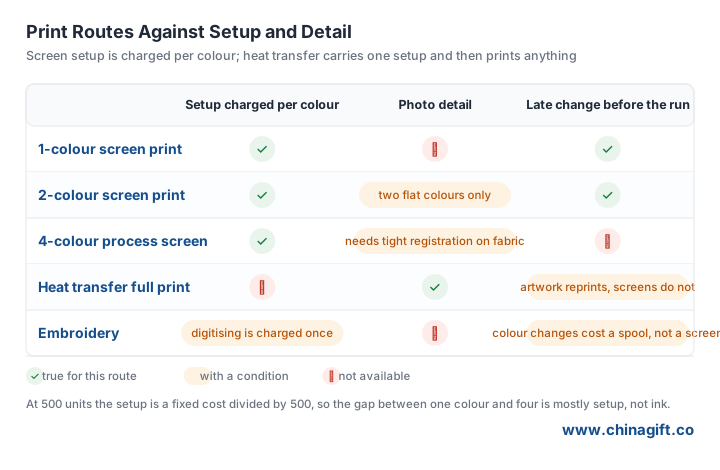
If the goal is a logo that reads across a crowded hall, one or two colours is the right call and the setup stays small. If the bag has to carry a sponsor wall, a map or a photograph, full print or heat transfer is the only route that holds detail, and the budget should be planned around the setup rather than the ink. If the artwork is not final and the event date is fixed, print what is settled in one colour now and keep the full print for the next run.

Send the artwork and the quantity and we will quote the conference bags range with the setup broken out per colour, so the comparison between one colour and full print is a number you can check instead of a single unit price that hides the difference.
Need promotional gifts for your campaign?
Send your brief and quantity for a quote and a digital proof.
Get a free quote


