Promotional Gift Compliance: REACH, Prop 65 and LFGB by Material
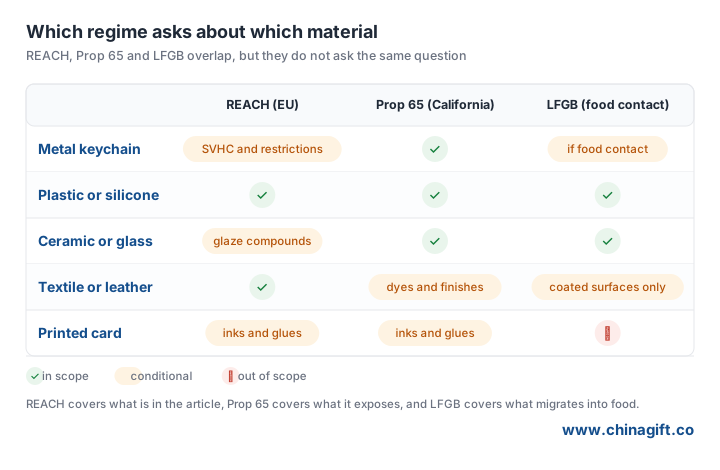
A promotional gift rarely fails compliance because the supplier lied. It fails because a test report was issued for one material and applied to the whole item, or because a metal keychain was tested for lead and the printed pouch it ships in was never considered. REACH, Prop 65 and LFGB are three different questions, and the material list on the purchase order decides which question applies to which part.
Start from the material, not the certificate
A test report covers a described sample: a material, a colour, a surface treatment and a set of test conditions. It does not cover the same gift produced in a second material, and it does not cover a colour change if the colour comes from a pigment. The practical rule is one report per material family per colour, not one report per product. A gift set with a metal clip, a plastic body and a printed card needs three lines of evidence, and a report that names only the plastic body leaves two thirds of the item undocumented.
Read the sample description on page one before reading any result. If it says "plastic part, black" and your order includes a white version, the report does not apply to half the shipment. This single check catches more gaps than any other.
Metal: what is actually being restricted
Metal gift items are usually brass, stainless steel, zinc alloy or aluminium, and the compliance questions follow the alloy rather than the shape. Lead appears in brass and in some solders and platings; cadmium appears in platings and in low-cost solder; nickel release matters where the item sits against skin, which is why a keychain loop or a bracelet clasp is treated differently from a bottle opener. Under REACH, nickel release from items in prolonged skin contact is restricted, and lead and cadmium are restricted in specific article categories rather than banned outright.

Under Prop 65 the question is different. It is not whether lead is present but whether the item exposes a user to a listed chemical above the level that requires a warning, and enforcement in California comes from private notices as often as from regulators. That is why a supplier who is fully documented for Europe can still be exposed on a US shipment, and why the two document sets are not interchangeable.
Plastic and silicone: the migration question
For anything that touches food, the regime changes from content to migration. EU framework Regulation 1935/2004 requires that a food-contact material does not transfer constituents in quantities that endanger health or change the food, and the plastics measure 10/2011 sets overall and specific migration limits, with the overall migration limit at 10 mg per square decimetre of surface. Testing uses simulants: water, dilute acetic acid, ethanol and vegetable oil, chosen to match the food the item will contact.
LFGB sits on top of this for the German market and adds a sensory requirement: the material must not impart odour or taste. A plastic item can pass a migration test and still fail the sensory panel, which is why the report has to state which test was run. Phthalates in soft PVC and primary aromatic amines in some nylon articles are the two questions that come up most often, and both are answered by a migration test under the conditions of use, not by a content test alone.
Ceramic, glass and printed surfaces
Glazed ceramics are judged on lead and cadmium release from the glaze, tested with an acetic acid extraction on the food-contact surface. A decorated rim that touches the lip is part of the food-contact surface, and a design that adds decoration there adds a test. Glass is generally the least problematic of the food-contact materials, but a sprayed or printed exterior still needs a migration check if the decoration can contact food or the hand.
Printed paper and card are the most commonly skipped category. Inks, varnishes and adhesives in a gift box or a sleeve can carry heavy metals and mineral oil, and they sit directly against the product in the same package. If the gift is a food item or a food-contact item packed in printed card, the packaging belongs in the compliance conversation, not outside it.
What the document pack should contain
Four elements make a report usable. First, a sample description that matches what you are buying, including colour and the specific part. Second, the test standard and the conditions, so a reviewer can tell whether the item was tested as a food-contact article or as a general consumer item. Third, the laboratory and the report date, because a five-year-old report on a supplier's previous factory is not evidence about this order. Fourth, the scope statement, which tells you what was not tested.
Ask for the pack by material and keep it with the order, not with the supplier file. When a second colour or a second factory enters the picture, the gap is then visible immediately rather than at the customs broker's desk.
Decide the materials before the samples
The cheapest compliance decision is made at the design stage, when there is still a choice. A single-material item needs one report; a metal-and-plastic assembly needs two; an item with a printed food-contact surface needs three. If the gift only has to look good in a photograph, printed card and a metal charm are a lighter document burden than a food-contact plastic moulding, and choosing the lighter route early is worth more than any negotiation later.
Then write the material list into the purchase order, one line per material, with the colour and the surface treatment. That list is what turns a compliance question into a checklist, and it is the difference between a supplier who sends the right reports and one who sends a report for something adjacent.
Need promotional gifts for your campaign?
Send your brief and quantity for a quote and a digital proof.
Get a free quote


