Multi-tool Keychain Compliance: Airline and Safety Rules
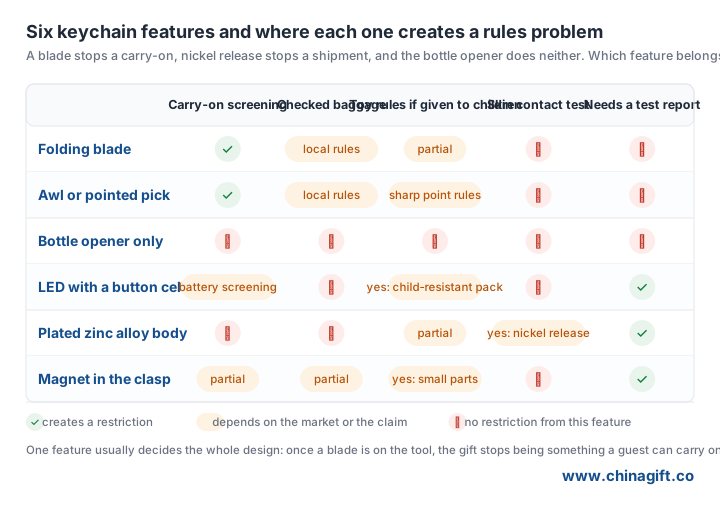
A multi-tool keychain is one of the cheapest corporate gifts to make and one of the easiest to get wrong, because the rules that apply to it are attached to the features rather than to the product. A bottle opener travels anywhere. Add a folding blade and the same keychain cannot go in a carry-on. Plate it in nickel and the shipment needs a test report. The design decision is therefore not a styling question but a routing question: where is this gift going to be carried, and by whom.
The Design Decision That Decides Whether the Gift Can Fly
Airport screening looks for a blade, and once there is a blade the answer is almost always no for carry-on, in every major market. The same tool can go in checked baggage in most places, but the guest at a trade show does not check a bag for a giveaway. So the useful question when you brief a supplier is not whether the tool is small, it is whether the tool has a cutting edge at all.
The designs that clear carry-on screening are built from a bottle opener, a flat screwdriver tip that is formed rather than ground, a ruler notch, or a phone stand. None of those present an edge that a screener can read as a weapon. If the concept needs a blade for the product to make sense, plan the distribution accordingly: desk gift, shipped to the office, or handed out at a venue where nobody is flying home the same night.
Blade, Awl and Pointed Parts: What Screening Looks For
A folding blade is straightforward. An awl, a leather punch or a pointed pick is the part buyers miss, because it has no edge and still reads as an implement on an X-ray image. The practical test is a sample in a carry-on on your next trip: pack one, and pack a second keychain without the pointed part, and see which one gets pulled. One trip with two samples settles a question that a supplier cannot answer for you.
Local rules differ enough that a single market approval is not transferable. A tool that passes in one country can be refused in another on the same itinerary, and the refusal happens at the gate rather than at the border, which is the worst possible place to discover it. If the campaign ships to several countries, ask for the no-blade version as the default and offer the bladed version as an opt-in for domestic distribution.
Nickel Release on Something That Lives in a Pocket
Nickel release is the compliance question that catches gift buyers, because it applies to items in prolonged skin contact and a keychain in a trouser pocket qualifies. Plated zinc alloy is the standard body material for this product family, and the plating that makes it look expensive is the layer that has to be tested. The test is a release test on the finished part, not a material declaration, and the report names the parts that were tested.
Ask for the report per plated part: body, split ring, and any decorative plate. A report covering the body alone does not cover the ring, and the ring is in contact with fingers all day. Where the plating fails, the usual fix is a different finish rather than a different alloy, which is why finish selection and compliance should be decided together rather than in sequence.
When a Keychain Is Legally a Toy
Nothing in the product changes when a keychain becomes a toy, but a great deal changes in the paperwork. The trigger is how the item is presented and who it is given to: a bright character shape handed to children at a family event is read as a toy, and toy rules bring migration limits on coatings, a sharp point and edge assessment, and an age marking on the packaging.
The practical line to hold is simple. If the item may reach a child, specify coatings that a toy test would pass, drop the small detachable parts, and print the age marking on the bag rather than adding it later as a sticker. A sticker is the detail that gets a shipment held, because it can be removed and it was not part of the approved artwork.
Button Cells and Magnets: Two Small Parts That Carry Rules
An LED keychain contains a button cell, and a button cell carries packaging rules in most markets because of swallowing risk. The requirement is normally a child-resistant pack plus a warning, and the warning has to be in the language of the market rather than in English only. If the gift is a flat card with a blister, the blister is the part that gets tested, not the keychain.
Magnets in a clasp carry a similar logic: a small, detachable, high-flux magnet is the item that gets regulated, and it is also the part that falls out first. Both features are cheap to keep and expensive to withdraw, so confirm them at the sample stage rather than after the artwork is printed on the card.

The Document Set to Request Before the Order
For a plated keychain the file is short: a nickel release report per plated part, a material declaration for the plating process, and a coating migration report if the item may reach children. If there is an LED, add the cell specification and the packaging warning artwork in the destination language. If there is a magnet, add the flux specification and the retention result from a pull test.
Ask for reports against the exact finish and part, and check the part names match the drawing. A report for a polished nickel finish does not cover an antique brass finish on the same body, and this is the mismatch that turns up in a customs hold rather than in a lab.
Send us the concept, the destination markets and whether the gift may reach children, and we will quote the no-blade version from the multi-function keychain range with the finish and the document set that fit those markets.
Need promotional gifts for your campaign?
Send your brief and quantity for a quote and a digital proof.
Get a free quote


