Metal Keychain Payment Terms: 30/70, LC and Trade Assurance
Payment terms are not a formality added at the end of a keychain order. They decide who carries the risk at each stage, and for a low unit value item the wrong structure can cost more than the margin. Three structures cover most bulk orders, and each one protects a different party at a different moment.
What Each Structure Actually Protects
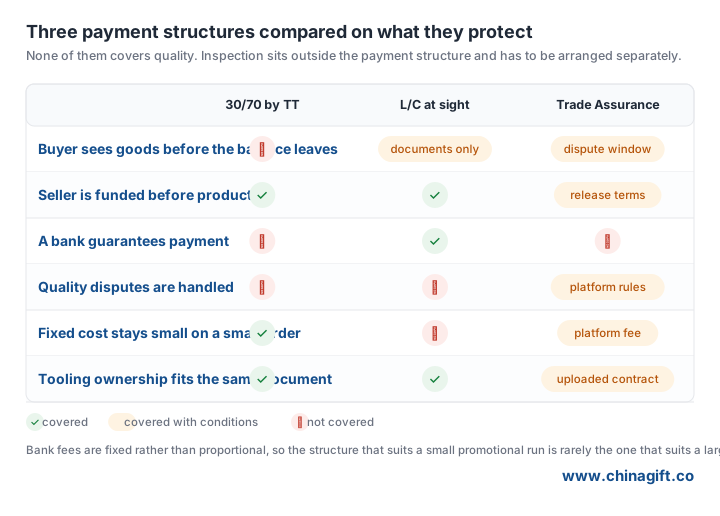
A telegraphic transfer split is a private arrangement between two companies. The bank moves money and takes no view on whether the goods exist. A letter of credit is a bank undertaking, which means a bank promises to pay if the documents match the terms exactly, and it takes no view on whether the keychains are any good. Platform escrow sits between the two: a third party holds the money and releases it on milestones, and the rules that decide a dispute are the platform rules, not the contract you wrote.
That difference matters more than the headline percentage. A buyer who pays 70 percent before shipment has bought a promise. A buyer who opens a letter of credit has bought a document check. A buyer who uses escrow has bought access to a dispute process. None of the three buys quality, which is why inspection sits outside all of them.
30/70 by Telegraphic Transfer: Who Holds the Risk and When
The common structure is 30 percent deposit with the order, 70 percent before shipment or against a copy of the bill of lading. The deposit funds material and plating, which is why suppliers ask for it: a die-cast or stamped keychain needs metal, a plating bath slot and a packaging run before a single unit is finished. Without a deposit the supplier is lending you working capital.
The buyer exposure is obvious. At the moment the 70 percent leaves, the goods are packed but not delivered, and the buyer has no leverage left if the plating is patchy or the logo is off-centre. Two adjustments reduce that exposure without changing the headline split. Pay the balance against a pre-shipment inspection report rather than against a packing photo, or move to a three-stage split with the final payment after arrival. The first is a document change; the second needs the supplier to agree to carry more of the risk.
Letter of Credit: What It Costs and What It Does Not Cover
A letter of credit substitutes a bank for the buyer. The bank pays when the documents conform: invoice, packing list, bill of lading, certificate of origin, and whatever else the credit text demands. It is the right tool when the two sides do not know each other and the order is large enough to justify the machinery.
What it does not do is inspect the goods. A credit that calls for a clean bill of lading will be honoured even if every keychain in the container is the wrong colour, because the bank checks paper, not product. The real risk in an L/C is documentary: one mismatched description, one late shipment date, one missing endorsement, and the bank refuses the documents and the payment stalls while the goods sit at the port.
The cost is also fixed rather than proportional. Issuing commission, advising fee, amendment fee and the collateral or margin the issuing bank requires all exist regardless of order size, which is why an L/C rarely makes sense on a small promotional run. Compare the total bank cost against the order value before deciding, and an amendment after issue is a second fee.
Trade Assurance and Platform Escrow: Where It Stops
Platform escrow is the cheapest of the three to set up and the most limited in scope. The money is held, and the release follows the milestones in the order as it was entered on the platform. If the supplier ships late, or ships a different quantity, the platform process is usually quick and the evidence is already in the order record.
Where it stops is at anything the platform did not record. A verbal agreement about plating thickness, a tooling ownership term, a side letter about spare parts: none of that is inside the escrow, and a dispute about it becomes a commercial argument. The coverage ceiling and the dispute window are also platform-specific, so read them before the order rather than after the claim.

Matching the Structure to the Order Size and the Tooling
Two variables decide the choice: the order value and whether the order carries tooling. Below a certain value, bank instruments cost a visible share of the order and a transfer split is the practical answer, with inspection doing the work that the bank cannot. Above it, an L/C becomes cheap relative to the risk it removes.
Tooling is the variable buyers forget. A new mould or a stamping die is paid upfront, it is specific to your design, and if the order is cancelled it has no resale value. Pay tooling as a separate line with its own document, and state who owns the mould, where it is stored, and what happens to it if a future order is not placed. A tooling clause costs nothing to write and is the single most useful sentence in a keychain contract.
What to Write in the Contract Before the Deposit
Five lines close most of the gaps. The payment split with the exact trigger for each release, in documents rather than in weeks. The inspection standard and who pays for the inspection. The tooling ownership and storage term. The tolerance for colour and plating, referenced to a signed sample. And the currency, with the exchange rate basis if the quotation is in a currency other than the invoice.
Then keep the documents in one file per order. A payment dispute is won or lost on what can be produced, and a clean file with a signed sample approval, an inspection report and a tooling clause is worth more than any clause negotiated after the balance has gone.
If you are placing a metal keychain order and want the payment structure and the tooling clause settled before the deposit, send the quantity, the design status and the destination, and we will quote with the terms laid out per milestone.
Need promotional gifts for your campaign?
Send your brief and quantity for a quote and a digital proof.
Get a free quote


