Bottle Opener Sample Policy: What Is Free, What Is Charged
A bottle opener sample is free or it is not, and the difference is almost never the supplier being generous. It is whether a die has to be cut. A stock shape pulled from the mould list costs the factory a unit and a courier label; a custom shape costs a die that nobody can reuse for another buyer. Once a buyer understands which of those two they are asking for, the sample invoice stops being an argument and becomes a line item.
Three Things a Sample Can Cost
Tooling. A custom silhouette needs a die, and the die is the expensive part. One-sided engraving uses a single die; a shaped body with a logo on both faces needs two, and a multi-part opener with a moving part needs an assembly jig on top of that. Tooling is a one-off cost per shape, not per sample, which is why a second sample of the same shape should not carry it again.
Material and finishing. The metal, the plating and the logo method. A sample in an existing plating colour is close to the unit cost of one piece. A sample in a new plating colour usually means a minimum bath or a small lot at the plating shop, which is a real cost even for one piece.
Freight. Courier is the line buyers most often forget to ask about, and the one most often quoted as an afterthought. Ask whether the sample ships on the supplier account or on yours, and get the answer before the sample is ready rather than after.
When the Sample Fee Is Refundable
The refund is a contract term, not a policy. Three versions are common, and only one of them is worth signing without reading closely.
Fully credited against the first bulk order. The cleanest arrangement: the sample invoice is deducted from the bulk invoice once the order reaches the quantity written on the sample invoice. Ask what happens if the bulk order is split across two shipments, because the credit is usually applied once, not twice.
Partially credited. Often the tooling is credited and the material, plating and courier are not. That is reasonable, since those costs were genuinely consumed by the sample, and it is worth having it stated in that split rather than as a percentage.
Not refundable at all. Usually applies to a new plating colour, a one-off print setup or a sample that was approved and then re-specced. If the supplier says non-refundable, ask which component is non-refundable, because "the sample" is rarely the right unit.
Two things should never be credited back. Courier is spent. A die cut for a shape you then abandon is spent as well, and a supplier who offers to refund it is usually planning to reuse the die for someone else, which is the next problem.
The Four Lines a Sample Invoice Should Show
Ask for the sample invoice as a document separate from the quotation, with the costs split rather than bundled.
Tooling, named by shape. One line per die, with the shape described in a way that matches your drawing. This line is what makes the credit easy to argue later.
Sample material and finishing. Include the plating colour and the logo method, because both drive the cost and both are the things you might change in revision two.
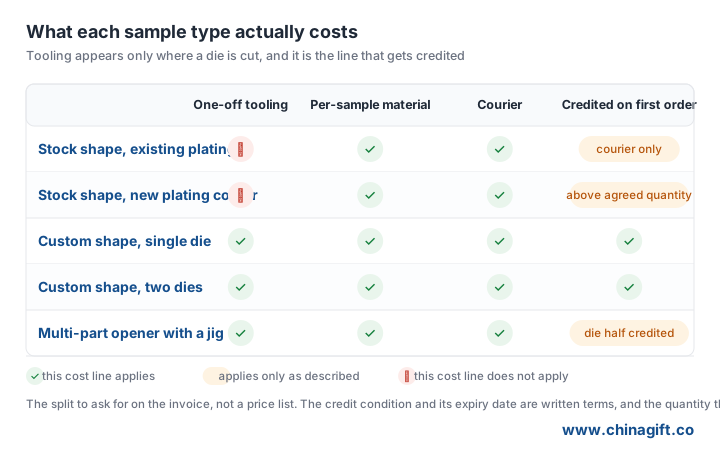
Courier, with the account named. Either the supplier pays and bills it, or it ships on your account. A line that says freight to be advised is the one that produces a surprise two weeks later.
The credit condition, written as a sentence. Not a note in an email — a sentence on the invoice: credited against the first bulk order of at least the stated quantity, valid until the stated date. Without a date, the credit has no expiry and no supplier will honour it two quarters later.
The Disputes That Repeat
Four arguments come up often enough to pre-empt in writing.
The fee that reappears. A second sample of a shape already tooled arrives with the tooling line again. The fix is the invoice wording: tooling is one-off per shape, and revision samples of the same shape carry material and courier only.
Die ownership. If you pay for the die, ask in writing who owns it and whether it stays with that factory. Buyers who paid for tooling and then moved to a second supplier usually discover the die does not travel, and that is normal — but it should be a known term, not a surprise.
The sample that does not match the die. A sample can be hand-finished while the bulk comes off the die, and the two differ at the edges. Ask whether the sample is representative of production tooling, and if not, ask to see a tooled sample rather than a hand sample.
Free revisions with no ceiling. Two revisions inside the same tooling is a normal courtesy. Beyond that, the factory is re-cutting or re-plating, and it will either charge or quietly stop being responsive. Put the number of included revisions in the request, so neither side has to interpret silence.
What to Write Before You Pay

Name the sample type. Stock shape in an existing finish, stock shape in a new plating colour, or custom shape with a named die count. The three carry different costs and a request that says only sample please will be answered with the cheapest interpretation.
State the credit you expect. Tooling credited against the first bulk order above a stated quantity, valid to a stated date, with material and courier excluded. Writing the expectation first is what makes the counter-offer legible.
Ask for the courier decision up front. Supplier account or yours, and the service level. It is a small line and the only one that can delay a sample by a week.
Keep the sample and the invoice together. When the bulk order is placed, the credit is argued from the invoice, and the approved sample is the reference for whether the die did its job. Filing them as one document set takes a minute and settles both questions.
Browse the bottle opener range we already hold tooling for, and ask which shapes need no die at all. For a custom silhouette, send the drawing and we will quote the die separately from the sample, with the credit condition written on the invoice rather than agreed in an email.
Need promotional gifts for your campaign?
Send your brief and quantity for a quote and a digital proof.
Get a free quote


